How Candidate Ranking Works After a Civil Service Aptitude Test
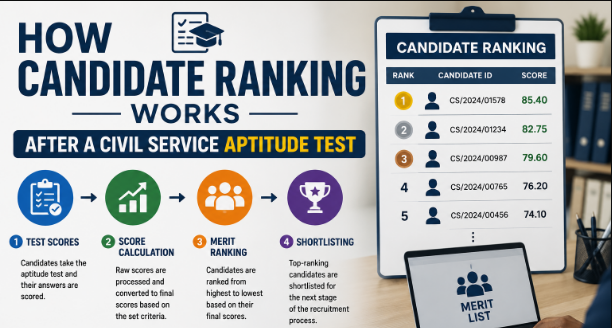
How Candidate Ranking Works After a Civil Service Aptitude Test: Many applicants assume that simply passing an aptitude test guarantees progression to the next stage, only to discover that ranking, rather than a simple pass or fail threshold, often determines who actually moves forward. Understanding how ranking typically works helps set realistic expectations about your results.
Pass Mark vs Competitive Ranking – An Important Distinction
Many civil service aptitude tests do have a stated minimum pass mark, but meeting that pass mark alone doesn’t necessarily guarantee progression, particularly for highly competitive recruitment exercises with far more qualified candidates than available positions. In these situations, candidates are typically ranked from highest to lowest score, and only a limited number from the top of that ranking are invited to proceed, even if many more candidates technically passed the minimum threshold.
How Ranking Interacts With Quota Allocation
As discussed in our dedicated guide on the quota system, ranking is often applied within each state’s allocated quota rather than purely on a nationwide basis. This means your ranking position is typically calculated relative to other candidates from your specific state of origin, not against the entire national applicant pool, which is an important distinction many applicants don’t initially realize.
What Happens in the Event of a Tied Score
When multiple candidates achieve an identical score at the cut-off boundary, agencies typically apply a secondary tiebreaker, which can include factors such as educational qualification level, age, or sometimes the order of application submission, depending on the specific agency’s published selection criteria for that exercise.
Can You Find Out Your Exact Score and Ranking?
This varies by agency, some publish individual scores directly on the candidate’s portal dashboard, allowing you to see exactly where you ranked, while others only communicate whether you’ve been shortlisted or not, without disclosing your specific score or ranking position. If this information isn’t automatically available, it’s reasonable to make a polite, formal inquiry through the agency’s official channel, though not every agency will disclose this level of detail.
A Practical Takeaway for Future Applications
If you didn’t progress despite meeting the stated pass mark, this likely reflects a highly competitive ranking situation rather than any fundamental shortcoming in your qualification. Use this as motivation to strengthen your overall profile, through additional relevant certifications or experience, for the next opportunity, rather than assuming the pass mark itself was somehow misleading.